
Sightings and records
Lake Cote: the photograph that turned a mapping flight into a mystery
From a routine flight in 1971 to examinations of the original negative: the people, records and unresolved debate behind Costa Rica’s Lake Cote photograph.
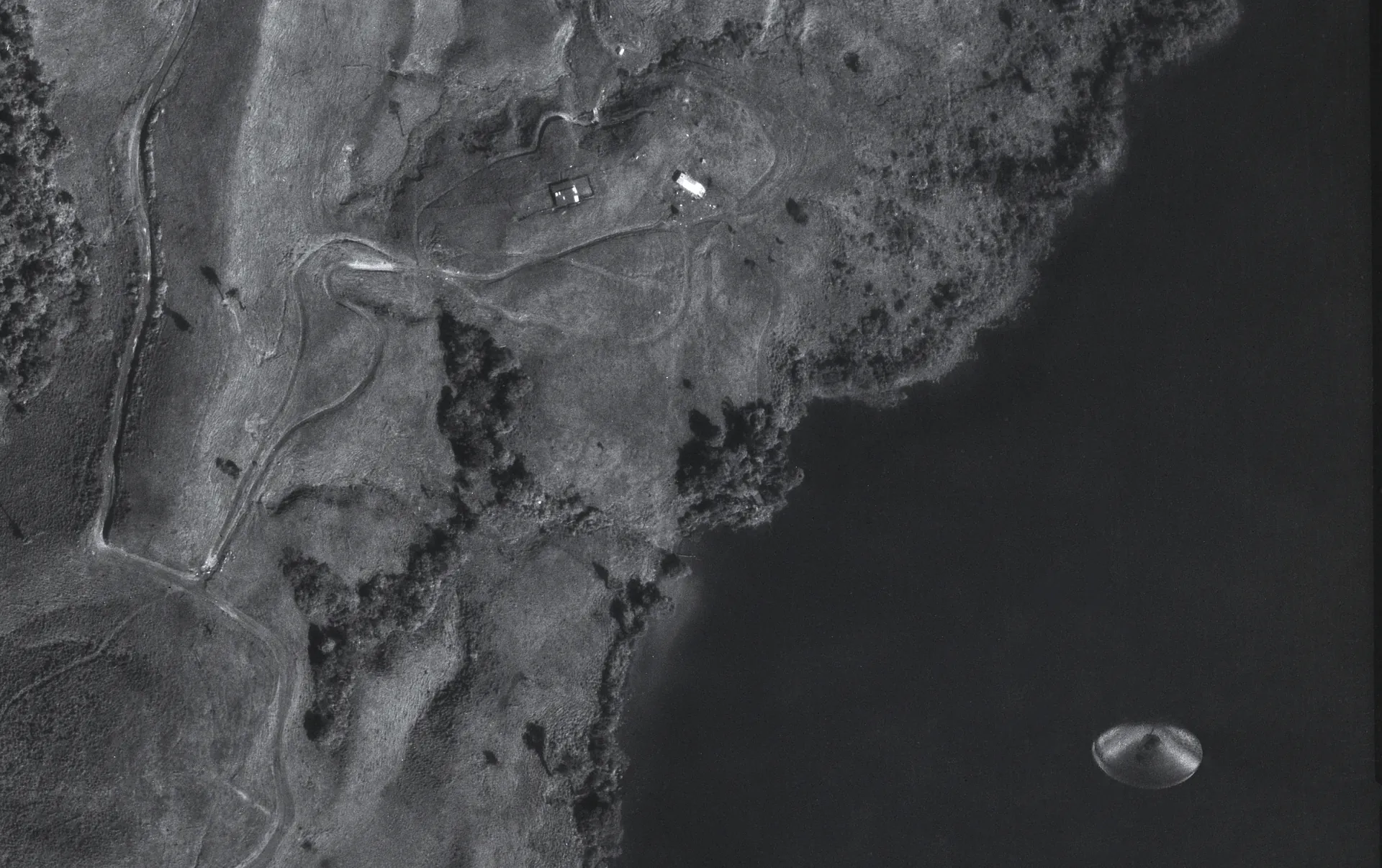
Nobody aboard announced an unusual sighting. On 4 September 1971, a working flight over the Arenal region produced an image that would acquire significance later, away from the aircraft. Against the dark surface of Lake Cote, near the edge of a photograph, was a pale, roughly disc-shaped figure.
Photographer Sergio Loaiza recalled in a 2021 interview that the discovery came during image review. The flight had answered a mapping request from ICE, Costa Rica’s electricity institute. A colleague noticed the figure at the photointerpretation table, and an enlargement was made for the director. The mystery began in an office routine: looking closely at material produced for another purpose. La Nación’s interview with Loaiza.
That origin distinguishes the case. The picture was not taken while following something a witness had pointed out in the sky. It was a mapping photograph in which someone later found something unexplained. A small detail gradually began to compete with the landscape around it.
The lake behind the disc
Cote has a natural history often overshadowed by the photograph. Costa Rica’s 2008 wetlands inventory describes a lake of approximately 198 hectares, about 650 metres above sea level, with a maximum depth of 18 metres. It presents possible origins involving volcanic processes or collapse associated with a fault, without settling on a definitive explanation. SINAC: Costa Rican wetlands inventory.
In the aerial image, the water serves another purpose. Its relatively uniform background makes the pale figure stand out. An enlargement isolates it until it becomes the entire subject. The full photograph restores the proportions of the problem: a small mark within a much larger territorial record.
Eight years before the newspaper
The picture did not become public immediately. La Nación published it on 1 November 1979. Loaiza recalled working abroad and receiving the newspaper from his wife. Eight years separated the flight from that publication.
The interval separates the taking of the photograph from the history of its circulation. The camera made the record in 1971; a wider public encountered it later. Each reproduction could acquire a different caption and a new claim. The little disc might appear beside a question or be presented as an answer the photograph alone could not provide.
The case also has an institutional record. Costa Rica’s National Archives catalogues three images dated 1971, attributed to the National Geographic Institute, under a title describing photographs of an unidentified flying object. Their reference is CR-AN-AH-FO-002544-1-002544-3. The catalogue documents that group’s existence and provenance; it is not a determination of what the figure represents. National Archives catalogue.
For a story dominated by copies, a catalogue supplies something useful: a date, a producer and a reference. It allows the document to be followed independently of cropped versions circulating online.
Disagreement inside the first analysis
In 1989, Richard Haines and Jacques Vallée published an analysis using a second-generation negative. They interpreted the figure as an opaque object and found no signs of double exposure. The paper also included Marilyn E. Bruner’s critical review. Edges and shading suggested to her a pressure mark or particle on the film; she proposed examining the original negative. Disagreement was part of the published study from the outset. Haines and Vallée, with Bruner’s review, 1989.
Their difference concerned the material itself. One interpretation placed the cause in front of the camera. The other considered whether the film could have produced the shape. They called for different investigations: identifying an object in the scene, or identifying a process affecting the photographic record.
A striking enlargement cannot settle that distinction by itself. Enlarging a picture helps inspection of the details available. It does not create another viewpoint or automatically establish the distance between the camera and an unexplained figure.
Returning to the original negative
In 1990, Haines and Vallée reported obtaining consecutive original frames 299, 300 and 301. The figure appeared in frame 300. Their examination found no film deformation supporting the pressure-mark hypothesis. They retained an unidentified-object interpretation and rejected several photographic explanations. This was the original investigators’ response to earlier objections, now based on different material. “New Evidence,” 1990.
The sequence appeared to offer a possibility: photographs before and after might reveal movement. But a figure missing from neighbouring frames does not automatically provide a measured trajectory. A speed calculation requires comparable positions and known distances. The time between exposures alone cannot supply both.
Size presents a related problem. A small figure on film can correspond to differently sized objects at different distances. An estimate based on placing the object at a particular altitude remains conditional on that placement. The visible shape can be described more confidently than its physical dimensions.
What survived the exchange was an intriguing record and a disputed interpretation. Choosing the most impressive enlargement does not remove the disagreement. Nor does disagreement erase the value of examining the material. The traceable discussion is what allows the case to be told precisely.
A working photograph’s second life
In 2026, Adam Pillon and Megan Woomer’s documentary project The Cote Photo returned to the image and people involved in its examination. Its website also presents a recent scan of the negative. The film adds another chapter to the picture’s circulation through newspapers, research papers and archives. Official documentary website.
Cote’s appeal lies in that journey. A camera recording territory left an unexpected shape; colleagues found it later; a newspaper brought it to new readers; researchers debated the material preserving it. The lake remained while the photograph changed audiences.
The small disc remains against dark water. Around it is a recoverable history of mapping work, personal memory and observation. The identity of the figure remains the question.